





On our fourth night in Puerto Madryn, we were sitting in a restaurant with our good friends Stuart and Gemma, and their new friends Bo and Cogi. The four of them had spent most of the day driving a rental car around the gravel roads of Peninsula Valdés, and I asked them if they'd had any luck spotting an orca.
Stuart's eyes lit up. "Yeah, we did. Not up on the beach, but out at sea.
But that's not all we saw!" And he pulled out his digital camera, and
started playing a video for me.
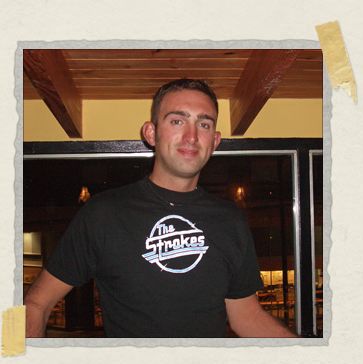
The four of them had arrived at Punta Norte rather early, it turned out, and so they had a lot of time to kill. (Orcas mostly appear around high tide.) Among the wildlife you can see on the peninsula is the armadillo: they're everywhere, absolutely adorable and a lot hairier than you might expect. One of them had evidently run across Stuart's path, so he had fired up his camera and chased after it.
The video showed the armadillo fleeing from the demented Scotsman, and leading him into the little parking lot before disappearing beneath a large van. The video then pans over to the man standing next to the van.
Stuart is sitting besides me, beaming. He leans over to me and says proudly, "Johnny fucking Knoxville."
Those unfamiliar with MTV's gross-out smash-hit Jackass might remember Johnny Knoxville as the bad guy from the film Men in Black II. What the former stuntman is most famous for, of course, is doing things like "testing" a protective cup and getting attacked by guard dogs while wearing a bunny suit. To a fan of Jackass, such as Stuart, running into Johnny Knoxville is like meeting a rock star. Running into him in Patagonia is, well, a bit surreal.
Stuart told me he had a film crew with him, that they were setting up to do some stunt.
I couldn't figure out what on earth Knoxville could have had planned for Punta Norte, and said as much to Stuart. He shrugged.
"Trying to get eaten by killer whales, I guess."
At the end of the 19th century, Welsh settlers arrived in Patagonia. Among the towns they founded was Gaiman, which we toured while in Puerto Madryn. Gaiman is a curious little place, where ditches alongside the streets irrigate trees native to Wales, where you're more likely to hear Welsh being spoken than Spanish (the residents are all bilingual), where you're more likely to run into scones than empanadas.
On August 31, 1995, Princess Di famously visited here. She had tea at a place called "Ty Te Caerdydd" and was serenaded in Welsh by the local children's chior. When she died, a little shrine was built to her, one which residents adorn with flowers every August 31st.
Our tour stopped at a similar little teahouse, called "Ty Gwyn", and we all piled in. Inside, it really did feel like we had left Patagonia and stepped onto the British Isles. The walls were stone and oak, there was a fire burning in the fireplace, and bagpipe music was quietly playing (yes, I said "bagpipes" and "quietly" in the same sentence).
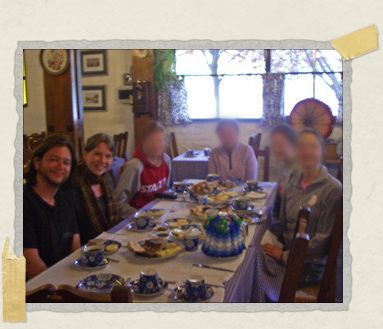
If Jessica and I were excited for the tea and cakes we were about to enjoy, the four Irish girls on the tour with us (whose names we didn't catch) were ecstatic. The six of us sat at a table together and were happily going about the business of becoming friends when it happened.
Over to our table ambled the proprieter, a round little woman with a broad, friendly smile. Her Spanish had a fascinating lilt, which I realized must be a touch of a Welsh accent. She was making the standard waitress small talk, noting that their were six of us, and had begun asking us another question when, out of nowhere, she was cut off by one of the Irish girls.
"English," the girl demanded, in the contemptous tone you might use if you were addressing a very badly-behaved child.
The woman blanched, as if struck, and then gave us all a heart-breakingly apologetic look before starting over in English.
I felt sick. Jessica looked furious. The other three Irish girls nodded approvingly at their friend.
We wanted desperately to swtich tables all of a sudden, but contented ourselves by making sure to speak nothing but Spanish to the poor woman the rest of the time we were there. I only speak a handful of words in Spanish, myself: hola, gracias, sí, and so on. But I stuck with them, trying with my limited vocabulary to distance myself from how shockingly rude the Irish girl had been.
Now, don't get me wrong. I've begun many a conversation with "¿Por favor, hablas Inglés?" I mean, I'm working on my Spanish, but right now I usually just panic and figure that it's at least worth checking whether the other person speaks English.
But to just say "English!" as if she need to be scolded for speaking Spanish, oh my. There are no words.
No words at all.

K
poor cute round lady. i hope you tipped her well. (and enjoyed the tea!)
~m
Yeah on the wildlife sightings! We saw quite a few armadillos in Florida, Alabama, Mississippi (god, I love to spell that word), however, all the ones we saw were road kill.